
Fish Games: How Real-Money Arcade Games Work and How They Differ from Slots
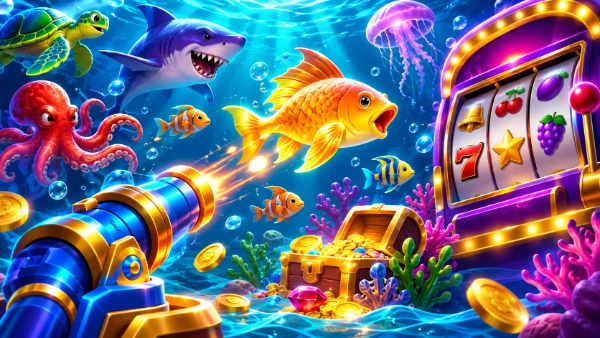
Fish Games combine arcade-style shooting with real-money gambling, replacing traditional slot reels with moving underwater targets, cannons and interactive gameplay. Players spend credits on ammunition, aim at different sea creatures and receive payouts when their shots successfully capture a target. Although the action resembles a conventional video game, financial results depend on the game’s underlying rules, which may involve both player decisions and random outcomes. By 2026, fishing-shooting games have become an established category of casino entertainment, with titles featuring multiplayer environments, special weapons, bonus creatures and different betting options. Understanding how ammunition costs, target multipliers and winning probabilities interact is essential because an entertaining shooting sequence does not necessarily produce a profitable result.
How Fish Games Work in Online Casinos
Fish Games, also known as fishing-shooting games or fish table games, originated from arcade entertainment built around underwater shooting challenges. Instead of collecting points simply to achieve a high score, real-money versions attach financial value to ammunition and successful captures. The player controls a cannon positioned around an underwater scene populated by fish, crabs, sharks and other animated creatures. Each target moves independently across the screen, sometimes disappearing before it can be captured. The objective is to shoot selected creatures and receive the rewards assigned to them. Unlike traditional fishing simulators, these games rarely involve casting a line or waiting for a bite. Their defining feature is continuous action, where the player repeatedly chooses when to shoot, which targets to pursue and how much to spend on each attempt.
The most important financial detail is that ammunition normally represents a wager. In a common configuration, the cannon level determines the cost of each projectile, with higher settings producing more expensive shots. For example, a player using ammunition worth £0.10 spends £1 after ten shots, regardless of whether any fish has been captured. If a successful target awards 15 times the qualifying shot value, the resulting payout would be £1.50. This represents the gross award rather than the overall profit from the session. A player who spent £2 on ammunition before receiving that £1.50 reward would still be £0.50 down. Actual calculations differ between titles, particularly when several weapons, special ammunition or additional rewards are involved. The game’s paytable and betting rules determine the amount awarded.
Fish Games frequently feature several target categories with different rewards and capture characteristics. Smaller fish commonly carry modest multipliers, while sharks, dragons, giant crabs and other special creatures may offer substantially larger prizes. Some titles also introduce powerful enemies known as bosses, which appear periodically and become prominent targets for players. These creatures can require repeated shooting or trigger special capture conditions, depending on the game. A large displayed multiplier should not be confused with an easy opportunity to win. Its value must be considered alongside the probability of a successful capture and the amount spent pursuing it. A target offering 100 times the ammunition value can still produce an overall loss if unsuccessful shots cost more than the eventual award.
Weapons, Special Features and Multiplayer Sessions
Weapons give Fish Games much of their distinctive arcade character. A standard cannon may fire individual projectiles, while particular titles offer lasers, nets, bombs or other special attacks. Some weapons can affect several creatures simultaneously, whereas others concentrate on a single target. For example, TaDa Gaming’s Ocean Hunter includes net-based capture mechanics and additional ammunition features linked to an energy system. Such functions change the visual experience and provide different ways of interacting with targets, although their actual financial effects depend on the published rules. More powerful-looking weapons do not automatically deliver better value. Players should establish whether special attacks require extra credits, activate after meeting specific conditions or form part of the normal ammunition system before using them.
Automatic shooting is another familiar feature. Rather than pressing the fire button repeatedly, players may be able to activate continuous firing or choose a target for the cannon to follow. This can make gameplay less demanding, particularly when numerous fish are moving across the screen. However, automatic fire can also consume credits rapidly because wagers continue while the feature remains active. Lock-on functions, where available, may help direct shots towards a selected creature, but they do not guarantee capture. Some games also provide temporary weapon upgrades, bonus rounds or special creatures that affect nearby targets. These features should be understood individually rather than treated as evidence that the game becomes more favourable after a particular number of shots. Their outcomes remain subject to the software’s specific mechanics.
Multiplayer fishing rooms allow several participants to target creatures within the same underwater environment. Traditional fish table cabinets have commonly supported multiple players seated around one central screen, while online versions reproduce a similar shared experience through digital interfaces. Participants may use different cannon values and pursue the same large creature, creating competition for valuable targets. The allocation of rewards depends on the individual title. Some games use particular rules to determine which player receives a capture award when several people shoot the same fish. Consequently, another participant’s success does not necessarily indicate anything about the next player’s chances. Shared action can make Fish Games appear more social than ordinary slots, but the presence of other players should never be interpreted as a guarantee of increased winning opportunities.
Fish Games vs Slots: Gameplay, Betting and Winning Chances
The clearest difference between Fish Games and online slots concerns how players interact with the game. A conventional slot begins when the player selects a stake and activates a spin. The reels then display symbols, and the game evaluates the resulting combinations against its paytable. Fish Games replace that sequence with continuous movement and repeated shooting. Players select targets, adjust cannon settings and determine how frequently to fire. This creates a stronger impression of direct participation because actions take place throughout the session rather than primarily before each spin. Nevertheless, the distinction in presentation should not obscure the financial similarity: both types of real-money games involve staking money on outcomes that may produce winnings or losses. Neither format offers a reliable method of generating profit.
Betting is also structured differently. In most slots, the selected wager represents the cost of one spin, although features such as bonus purchases or additional betting options may change that amount. In Fish Games, spending is commonly linked to each projectile. A player can therefore place numerous small wagers within seconds without receiving a separate confirmation for every shot. Consider a cannon charging £0.20 per projectile. Firing 50 times costs £10, while 200 shots cost £40 before accounting for any payouts. Increasing ammunition value to £0.50 makes those same shooting sequences cost £25 and £100 respectively. These examples illustrate expenditure rather than typical session costs. The actual amount depends on shooting frequency, ammunition settings, gameplay duration and the number of credits returned through successful captures.
Winning patterns differ because a Fish Game’s reward is usually associated with capturing a particular creature rather than forming a line or cluster of matching symbols. Slots may offer fixed paylines, ways-to-win systems, cascading symbols, free spins and bonus rounds. Fishing-shooting games instead use target values, capture events and sometimes special attacks that generate additional awards. Both formats can produce occasional larger payouts alongside numerous smaller results, but their volatility cannot be established solely from their appearance. A Fish Game featuring giant bosses is not necessarily more volatile than a particular slot, just as frequent captures do not automatically mean a higher return. Meaningful comparisons require information about the game’s actual probabilities, payout structure and theoretical return, where these details are available.
Does Player Skill Influence the Results?
Fish Games encourage players to make decisions that ordinary spinning slots generally do not require. Aiming, following moving targets, selecting ammunition values and choosing when to fire may all be relevant to gameplay. However, visible interaction should not be mistaken for complete control over financial outcomes. Some games use predefined probabilities to determine whether a target is captured, even when the player’s projectile appears to make contact. Others incorporate specific aiming or timing mechanics. The precise balance between skill and chance depends on the individual game. Gaming Laboratories International’s 2026 standards for shooting, fishing and target games explicitly address random outcomes and require games to inform players when aim or timing affects results. This distinction matters because hitting a creature visually does not always mean that a monetary award has been earned.
A sensible approach to target selection begins with understanding the relationship between cost, payout and the probability of capture. Small creatures often represent lower-value targets, while large bosses promise greater rewards but may be harder to capture. Concentrating exclusively on high-value fish can consume substantial ammunition without producing a win. Conversely, repeatedly targeting smaller creatures does not remove the game’s underlying financial disadvantage. Players can control their stake level and shooting frequency, and they may be able to avoid unnecessary expenditure by limiting attempts on difficult targets. These decisions influence how quickly money is spent, but they do not establish a dependable winning strategy. Claims that a particular shooting pattern, cannon setting or sequence of targets guarantees success should therefore be treated with caution.
The distinction between skill and chance also has legal importance. Under the UK’s Gambling Act 2005, a game involving both chance and skill can still qualify as a game of chance for regulatory purposes. The UK Gambling Commission explains that chance does not need to dominate the outcome for a game to fall within that definition. A genuinely skill-based prize game is assessed differently, but its classification depends on how the game actually operates rather than how it is advertised. Consequently, calling a Fish Game an arcade shooter or a skill game does not automatically remove gambling requirements when money and chance are involved. Players should not assume that real-money fishing games are legally available everywhere simply because they resemble familiar arcade entertainment.

Understanding Payouts, Risks and Responsible Play
Before playing a real-money Fish Game, it is important to distinguish between a displayed reward multiplier and the probability of receiving that reward. A fish marked with a 20x value may offer a payout calculated from the qualifying ammunition stake, but the multiplier alone says nothing about how often that fish can be captured. Some games display detailed paytables, weapon descriptions or information about the chance-based elements of their mechanics. Others provide less extensive explanations. Where a theoretical return to player percentage, or RTP, is published, it describes a statistical expectation over a very large number of wagers rather than the amount a player should expect back from one session. A 96% theoretical RTP, for example, corresponds to an average return of £96 per £100 wagered across the relevant statistical model, not a promise that every player will recover £96.
Repeated ammunition purchases can make the financial results of Fish Games difficult to judge without tracking total expenditure. A session might contain several successful captures while still ending in a loss because the accumulated cost of missed shots exceeds the awards. For example, suppose a player spends £30 on ammunition and receives payouts of £8, £12 and £6. The combined awards total £26, leaving a net loss of £4. If the player then spends another £15 pursuing a large boss without receiving a reward, the overall loss increases to £19. The correct calculation is always total payouts minus total stakes, including the cost of ammunition used before and after successful captures. This is more informative than counting how many fish were caught or focusing exclusively on the largest individual win.
The pace of play deserves particular attention. Unlike a slot session where individual spins provide clear starting and finishing points, Fish Games can present uninterrupted activity with creatures constantly entering and leaving the screen. Automatic shooting, changing targets and recurring special events may encourage longer sessions than originally intended. A player who concentrates on recovering money spent pursuing a boss can increase losses by continuing to fire after reaching a planned budget. The appearance of a valuable creature also creates no obligation to pursue it. Previous unsuccessful shots do not, by themselves, establish that a capture is due. Unless a specific game explicitly includes a progress mechanic with disclosed rules, the number of shots already fired should not be interpreted as evidence that the next attempt will succeed.
How to Assess a Fish Game Before Playing for Money
The first practical consideration is whether the game’s rules explain how wagers and rewards are calculated. Players should be able to identify the cost of each shot, available cannon settings, target multipliers and the conditions governing special features. It is equally important to establish whether visual hits always result in captures or whether a separate probability determines the outcome. Information about the theoretical RTP or winning likelihood, where required and available, provides additional context. In Great Britain, the Gambling Commission’s remote technical standards require licensed operators to make applicable game rules accessible before customers commit to gambling and to provide appropriate information about winning chances. The absence of clear explanations makes it difficult to evaluate what a player is paying for or how the displayed rewards are actually awarded.
Availability and legal status require separate checks. Real-money Fish Games are offered in different forms across international markets, and a game accessible through one website may not be authorised in another jurisdiction. In Great Britain, operators providing remote gambling services to consumers generally require the appropriate UK Gambling Commission licence. A licence issued elsewhere should not be assumed to authorise gambling services for British customers. It is also important to distinguish regulated online casino games from unlicensed cash-prize arcade arrangements that may use similar fishing graphics. Before depositing money, players should verify the operator’s authorisation, the applicable age restrictions, account verification requirements and withdrawal conditions. A familiar game design or recognised software developer does not independently establish that the service offering it is lawful.
Responsible play ultimately depends on treating Fish Games as paid entertainment rather than an income opportunity. Setting an affordable spending limit before starting, selecting an ammunition value that fits that limit and monitoring the total cost of shots can help prevent unexpected expenditure. A separate time limit is useful because continuous shooting can make sessions feel shorter than they are. Players should avoid increasing stakes to recover losses or assuming that a difficult target becomes more likely to pay after repeated attempts. Real-money Fish Games offer a different style of interaction from traditional slots, with greater emphasis on movement, targeting and weapon selection. Their central financial principle, however, remains unchanged: every wager carries risk, potential rewards are uncertain, and the most important information is found in the game’s actual rules rather than its visual effects.